


 Photo: P e z i · CC BY-SA 3.0
Notre-Dame de Paris
Cathedral · Paris
The place's story
 Essential
What to see
Notre-Dame stands on the Île de la Cité. Construction of the Gothic cathedral began in 1163 under Bishop Maurice de Sully; the main façade and its two towers took shape in the early 13th century.12
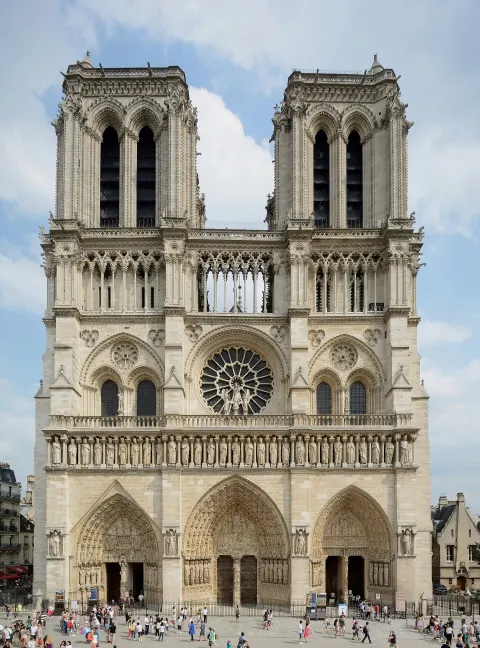
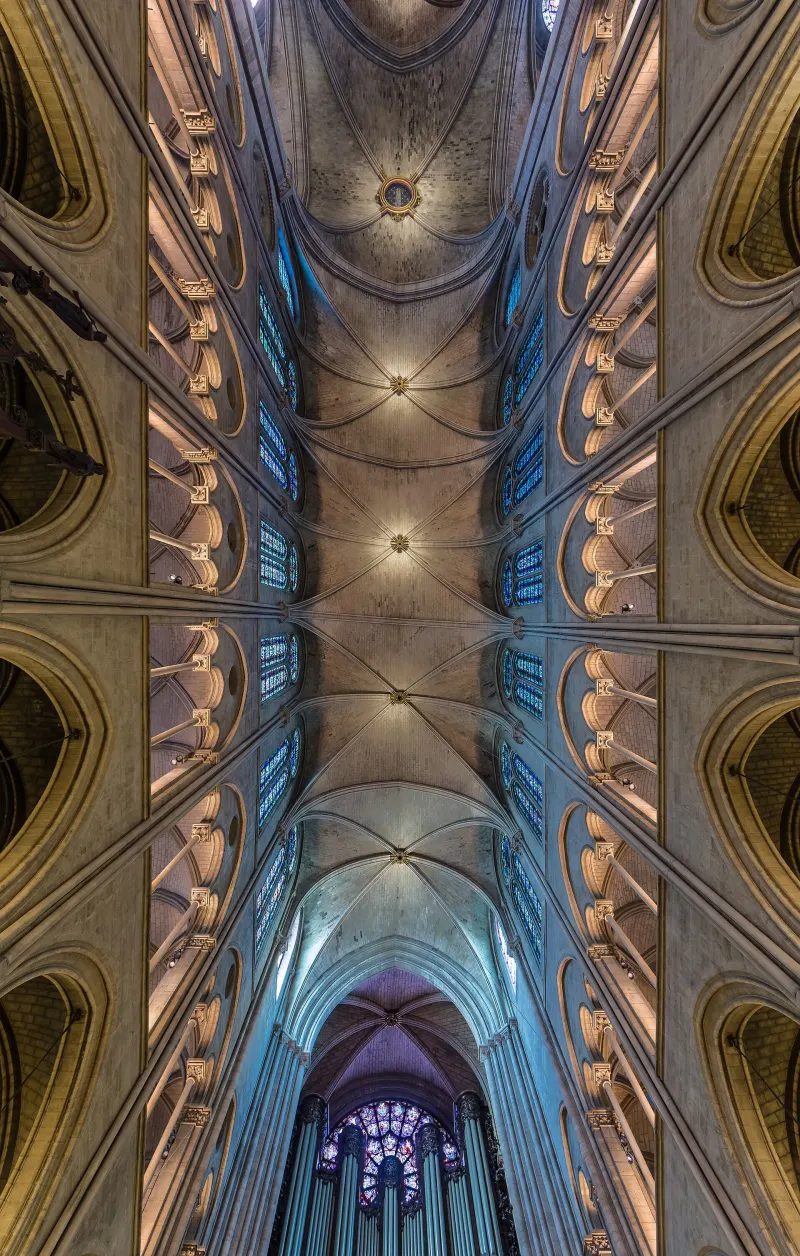
The west façade has three sculpted portals, a row of kings and a central rose window between its towers.13 Outside, flying buttresses brace the choir; inside, look across the transept for the two large rose windows. The north rose retains almost all its original 13th-century glass, while the south rose has been extensively restored.14

Fire and restoration
The fire of April 2019 destroyed the roof structure and spire. Notre-Dame reopened in December 2024 after repairs that included rebuilding the collapsed vaults, oak roof framework and spire.56
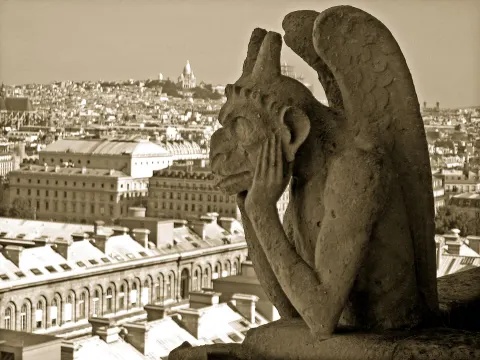
The spire itself recalls an earlier restoration: architect Eugène Viollet-le-Duc designed its predecessor in the 19th century and added the cathedral’s decorative chimeras.15 Exterior restoration continues, including work on the apse and flying buttresses.5
Visiting
Cathedral admission is free. A timed reservation is optional but recommended during busy periods; slots are generally released one or two days ahead or on the day.7
Usual hours are 7:50 a.m.–7 p.m. on weekdays, with Thursday opening until 10 p.m., and 8:15 a.m.–7:30 p.m. on weekends. Last entry is 30 minutes before closing, and services or special events can alter access.7
Sources7 sources
 Architecture of Notre-Dame de Parisnotredamedeparis.fr
 NOTRE DAME DE PARIS IN MORE THAN 100 WORKSparismusees.paris.fr
- The Western Facade - Notre-Dame de Parisnotredamedeparis.fr
- Interior Architecture - Notre-Dame de Parisnotredamedeparis.fr
 The program of restoration workrebatirnotredamedeparis.fr
- UAudrey Azoulay salutes the rebirth of Notre-Dame in Paris ...unesco.org
- What are the cathedral’s ...notredamedeparis.fr
 Balanced
A cathedral shaped over centuries
Notre-Dame stands on the Île de la Cité in the Seine. Bishop Maurice de Sully began construction in 1163, and the choir, nave and western façade were substantially complete by 1250; chapels and other additions followed over the next century.123
The cathedral was damaged during the French Revolution and extensively restored in the 19th century. Victor Hugo’s 1831 novel The Hunchback of Notre-Dame helped renew interest in the building; architect Eugène Viollet-le-Duc’s restoration included the spire that stood above the crossing until 2019.45
What to notice
The west front is arranged in distinct horizontal bands beneath two square towers. Its three sculpted doorways are dedicated to the Virgin, the Last Judgment and Saint Anne; the Last Judgment portal is the larger central one. Above them, the Gallery of Kings contains 28 figures representing kings of Judea. The statues now in the gallery were made during the 19th-century restoration.6
Inside, the tall nave, stone vaults and stained-glass rose windows show how Gothic architecture combined height with light. Flying buttresses outside help resist the outward thrust of the vaults, allowing for relatively slender supports and large windows. The three great rose windows contain 13th-century glass.12
Fire and restoration
The fire of April 15, 2019 destroyed the timber roof structure and the spire. Firefighters saved the main structure, including the towers and western façade, along with many artworks and relics.7 The spire was subsequently rebuilt, and the cathedral reopened for worship and visits in December 2024.85
Restoration work has continued on the towers, roof and apse.8 Changes around the cathedral are also in progress: the City of Paris says the wider redevelopment of the surroundings is scheduled to be largely complete in 2028.9
Visiting and worship
Admission to the cathedral is free. A timed reservation is optional but recommended during busy periods; free slots are generally released on the day, the day before or two days before a visit through the cathedral’s official website or app.1011
The cathedral lists weekday hours of 7:50 a.m. to 7 p.m., with a later 10 p.m. closing on Thursdays; weekend hours are 8:15 a.m. to 7:30 p.m. Last entry is 30 minutes before closing, and services or special events can change the schedule.10
Notre-Dame remains a working church, with separate entrances provided for services and Masses.12 The Crown of Thorns is displayed on Fridays, with a period of veneration on the first Friday of each month.13
Sources13 sources
 Notre-Dame de Paris | History, Style, Fire, & Facts | Britannicabritannica.com
- Notre-Dame de Parisbritannica.com
- 26 Historic Buildings to Visit the Next Time You're in Parisbritannica.com
- The History of Notre-Damenotredamedeparis.fr
 After Notre Dame fire, France restored cathedralseattletimes.com
- The Western Facade - Notre-Dame de Parisnotredamedeparis.fr
- BThe reconstruction of Notre-Dame de Paris: chronology ...brgm.fr
- How can I book a visit to the cathedral? - Notre-Dame de Parisnotredamedeparis.fr
 Notre-Dame de Paris: What Will the Area Around theparis.fr
- What are the cathedral’s ...notredamedeparis.fr
- Free admission : reservenotredamedeparis.fr
 Online reservation - Notre-Dame de Parisresa.notredamedeparis.fr
- Solemnity of the Assumption at Notre-Dame de Paris - 14 and 15 ...notredamedeparis.fr
 In depth
Setting and history
Notre-Dame de Paris stands on the Île de la Cité in the Seine and is the cathedral of the Catholic Archdiocese of Paris.12 Its long construction history is visible in the building: the choir and nave began in the 12th century, the great transept façades followed in the 13th, and the chapels and stonework around the eastern end continued into the 14th.3
Bishop Maurice de Sully began the cathedral in 1163. Builders worked first on the choir and its two ambulatories, then on the nave, west façade and towers; the principal early phase extended to about 1250.3 Subsequent work altered the original design, enlarging upper windows and adding chapels, so the cathedral is not a perfectly preserved example of one moment in Gothic architecture.43
The French Revolution brought confiscation and serious damage, including the destruction of sculptures in the Gallery of Kings on the west front. Catholic worship was restored after the Concordat of 1801, and Napoleon’s coronation took place in the cathedral in 1804, when temporary decorations concealed parts of the dilapidated interior.5
Victor Hugo’s 1831 novel Notre-Dame de Paris, known in English as The Hunchback of Notre-Dame, helped renew interest in the building. In 1844, architects Jean-Baptiste Lassus and Eugène Viollet-le-Duc were selected for a major restoration; after Lassus’s death, Viollet-le-Duc continued the project.26 Much of what is familiar today, including the sculptural chimeras and the design of the spire reconstructed after the 2019 fire, reflects that 19th-century intervention rather than the surviving medieval building alone.367
The west façade
The west front is arranged in three vertical sections, with three sculpted portals below a long row of figures, the central rose window and the twin towers. Four buttresses give the façade its strong vertical divisions, while galleries and horizontal bands connect the composition across its width.8
The central entrance is the Portal of the Last Judgment. To its left is the Portal of the Virgin, and to its right is the Portal of Saint Anne.9 Their carvings present biblical figures and Christian subjects in stone; the portals also show the effects of the 19th-century restoration, when damaged sculpture was repaired or recreated.86
Above the portals, the Gallery of Kings contains figures representing biblical kings. Its medieval sculptures were damaged during the Revolution, and the gallery was recreated in the 19th century.53 Higher still, a statue of the Virgin stands before the rose window, with Adam and Eve placed on either side; this sculptural arrangement dates from Viollet-le-Duc’s restoration.8
The towers rise to approximately 69 metres. The south tower was built around 1220–1240 and the north tower around 1235–1250.8 High on the building, the fantastical chimeras are a reminder that Notre-Dame’s familiar medieval-looking silhouette includes details created in the 1800s.3
Transepts, spire and exterior structure
The north and south transept façades project from the cathedral’s long body. On the north, the Cloister Portal has a Virgin and Child on its central pier; scenes carved above include episodes from Christ’s childhood.10 The façade was begun under Jean de Chelles in the mid-13th century.10
On the south, the Saint Stephen Portal is named for the first Christian martyr. Its carved scenes show Stephen preaching, appearing before a judge, being stoned and being buried. Jean de Chelles began the portal, and Pierre de Montreuil completed it.11
The flying buttresses are particularly visible around the choir and eastern end. These exterior arches help support the high walls, allowing the upper parts of the cathedral to contain large windows. The buttresses and the eastern chapels were modified and extended during the cathedral’s successive medieval building campaigns.39
The spire over the crossing is a reconstruction of Viollet-le-Duc’s 19th-century design. The previous spire was destroyed in the 2019 fire; the replacement was built with a solid-oak structure as part of the restoration.7 Its form belongs to the cathedral’s 19th-century history, even though the structure visible today is new.
The guide goes on in the app: 8 min in all.
Sources11 sources
- After Notre Dame fire, France restored cathedral — except these windowsseattletimes.com
- The History of Notre-Damenotredamedeparis.fr
- Architecture of Notre-Dame de Parisnotredamedeparis.fr
- Interior Architecture - Notre-Dame de Parisnotredamedeparis.fr
 Notre-Dame de Paris: From Flames to Rebirth | Alliance Française Berkeleyafberkeley.org
- The Cathedral in The Contemporary Era - Notre-Dame de Parisnotredamedeparis.fr
 Notre-Dame de Paris: project certification awarded for rebuilt roof structurepefc.org
- The Western Facade - Notre-Dame de Parisnotredamedeparis.fr
- Exterior Architecture - Notre-Dame de Parisnotredamedeparis.fr
- The North Facade and the Cloister Portal - Notre-Dame de Parisnotredamedeparis.fr
- The Saint Stephen Portal - Notre-Dame de Parisnotredamedeparis.fr